US Travel Tech 2026: 3 Gadgets to Transform Your Journey

The world of exploration is undergoing a radical shift as we enter a new era of digital mobility. From AI-powered planning to revolutionary hardware, US Travel Tech 2026 is setting the stage for a smarter, more integrated way to traverse the American landscape and beyond.
These modern American innovations are moving beyond simple convenience to provide truly proactive assistance.
This year’s breakthroughs focus on seamless connectivity and intelligent design, ensuring that modern voyagers stay powered, tracked, and stress-free throughout their entire itinerary.
Forget clunky gear of the past; the current wave of portable solutions is sleek, multifunctional, and highly efficient.
We have identified three standout devices that define this state-of-the-art movement, fundamentally upgrading how you interact with the world during your next adventure.
The Dawn of Intelligent Navigation: AI-Powered Personal Guides
The reliance on static maps and generic guidebooks is rapidly becoming a relic of the past as intelligent navigation systems integrate artificial intelligence.
These AI-powered personal guides are designed to offer dynamic, real-time assistance, adapting to individual traveler preferences and unforeseen circumstances.
Imagine a travel companion that understands your interests, anticipates your needs, and seamlessly reroutes you around unexpected delays, all while providing rich contextual information about your surroundings. This level of personalized guidance is a cornerstone of US Travel Tech 2026.
These sophisticated systems leverage vast datasets, including live traffic, weather patterns, local events, and even social media trends, to curate an optimal travel experience. They move beyond simple point-to-point directions, offering a holistic approach to exploration.
Real-Time Adaptive Itineraries
One of the most significant breakthroughs in US Travel Tech 2026 is the ability of these AI guides to create and adapt itineraries in real time.
If a museum closes unexpectedly or a restaurant has a sudden wait time, the system automatically suggests viable alternatives that align with your stated preferences.
This dynamic adjustment minimizes stress and maximizes efficiency, ensuring travelers spend more time enjoying their trip and less time troubleshooting. The AI learns from your choices, continually refining its recommendations for future journeys.
- Analyzes real-time data for optimal routing and activity suggestions.
- Learns user preferences to personalize recommendations dynamically.
- Provides proactive alerts for delays, closures, or opportunities.
- Integrates with booking platforms for seamless itinerary modifications.
Contextual Information and Language Translation
Beyond navigation, these gadgets excel at providing rich, contextual information about landmarks, historical sites, and local customs.
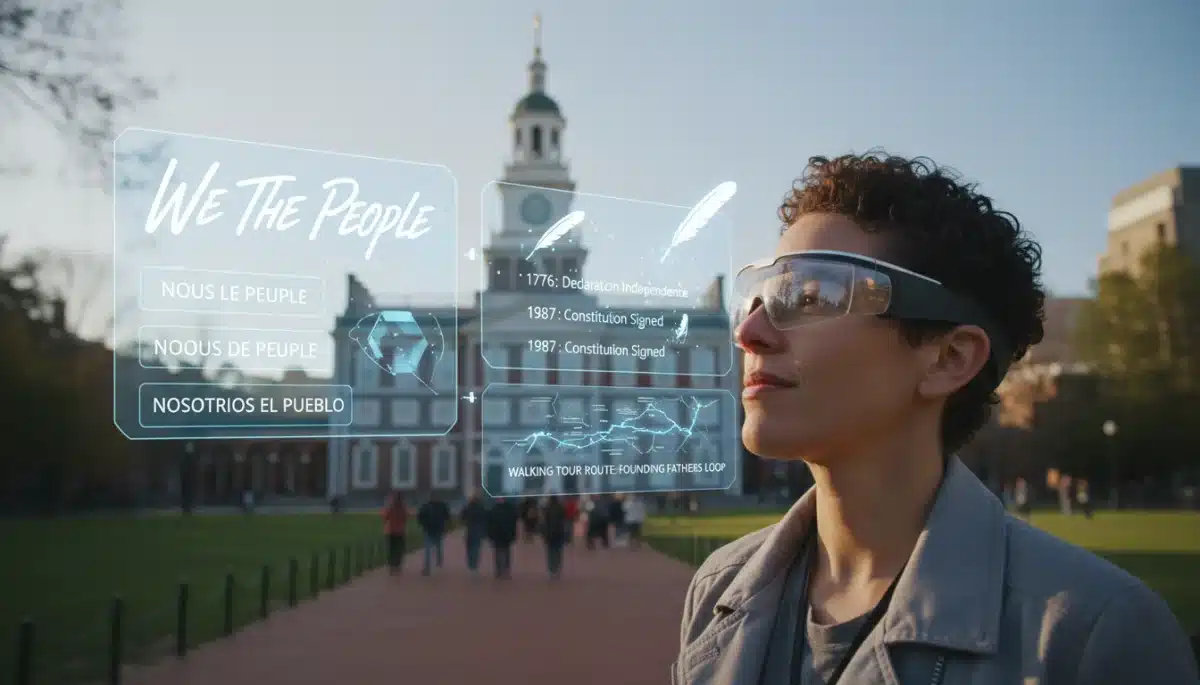
Point your device at a building, and the AI can overlay historical facts, architectural details, or even anecdotal stories, bringing your surroundings to life.
Crucially, advanced language translation capabilities are built directly into these guides, offering instant, accurate communication in foreign environments.
This feature breaks down significant barriers, making international travel more accessible and enjoyable for everyone embracing US Travel Tech 2026.
The integration of augmented reality (AR) further enhances this experience, allowing digital information to be seamlessly superimposed onto the physical world.
This creates an interactive and educational layer that transforms sightseeing into an active discovery process, fostering a deeper connection with destinations.
Seamless Security and Biometric Identification Devices
The future of travel security, as envisioned by US Travel Tech 2026, promises to be both more robust and less intrusive, thanks to advanced biometric identification devices.
These innovations aim to streamline airport and border control processes, reducing wait times and enhancing overall safety without compromising privacy.
Gone are the days of fumbling for passports and boarding passes. Next-generation biometric scanners, integrated into personal wearables or smart devices, will enable travelers to pass through checkpoints with unprecedented ease.
This shift represents a significant leap forward in travel efficiency.
The focus is on creating a frictionless journey from curb to gate, where your unique biological identifiers become your key to seamless passage. This technology is not just about speed; it’s about creating a more secure and reliable travel ecosystem for everyone.
Facial Recognition and Iris Scans at Checkpoints
The deployment of highly sophisticated facial recognition and iris scanning technology is a cornerstone of US Travel Tech 2026 in security.
These systems can accurately identify individuals in milliseconds, significantly speeding up the boarding process and security checks at airports.
Travelers will simply walk through designated lanes, with their biometric data verifying their identity against travel documents and watchlists. This automated process minimizes human error and reduces the need for manual document inspection, making the journey smoother.
The data collected is encrypted and managed with stringent privacy protocols, ensuring that while security is enhanced, personal information remains protected.
These systems are designed to be highly resistant to spoofing and fraud, offering a new level of confidence in travel security.
Smart Luggage with Integrated Tracking and Biometrics
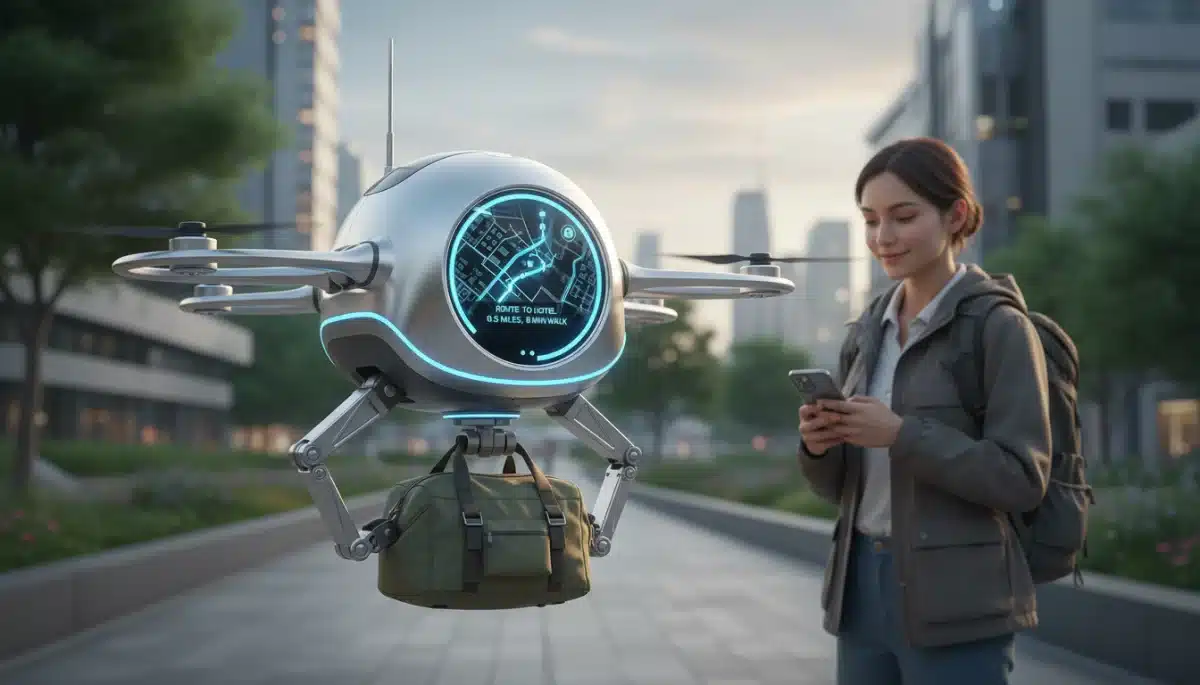
Another crucial element of US Travel Tech 2026 will be smart luggage, equipped with integrated tracking and biometric locks. These suitcases will feature GPS and cellular capabilities, allowing travelers to monitor their bags’ location in real time through a smartphone app.
Biometric locking mechanisms, such as fingerprint scanners, will replace traditional keys and combination locks, offering enhanced security against theft and unauthorized access.
This innovation provides peace of mind, knowing your belongings are secure and traceable throughout your journey.
- Real-time GPS tracking for luggage location monitoring.
- Fingerprint or facial recognition locks for enhanced security.
- Proximity alerts to prevent accidental bag loss.
- Integrated scales to avoid overweight baggage fees.
These smart luggage solutions are not just about security; they also offer convenience features like self-weighing capabilities and proximity alerts, further streamlining the travel process.
The integration of these features signifies a holistic approach to enhancing the traveler’s experience.
Immersive Entertainment and Connectivity Hubs
Travel in 2026 will be defined not only by efficient movement but also by unparalleled access to personalized entertainment and seamless connectivity, even in the most remote locations.
The next generation of gadgets under US Travel Tech 2026 focuses on transforming downtime into engaging experiences and ensuring travelers remain connected to their digital world.
These devices are designed to be personal entertainment hubs, offering a rich array of media, gaming, and productivity tools, all accessible through intuitive interfaces. They represent a convergence of wearable technology, advanced display systems, and robust internet access.
Whether on a long-haul flight, a scenic train ride, or simply relaxing in a hotel room, these gadgets ensure that boredom is a thing of the past and that vital communication is always within reach. This evolution is set to redefine how we pass time while traveling.
Portable Personal Cinema Devices
Imagine having a private cinema experience available anytime, anywhere. Portable personal cinema devices, a key component of US Travel Tech 2026, will offer high-resolution, immersive visual and audio experiences through compact, lightweight headsets or glasses.
These devices will project large virtual screens, complete with surround sound, allowing travelers to enjoy movies, TV shows, and games in stunning clarity without disturbing others.
They are perfect for long journeys, transforming cramped spaces into personal entertainment zones.
Advanced optics and ergonomic designs will ensure comfort during extended use, making these gadgets an indispensable part of any traveler’s kit. The content libraries will be vast, streaming directly from cloud services or stored locally for offline enjoyment.
Universal Connectivity & Satellite Hotspots
Staying connected while traveling often presents a challenge, but US Travel Tech 2026 addresses this with universal connectivity solutions and portable satellite hotspots.
These devices ensure reliable internet access regardless of geographical location, from urban centers to remote wilderness areas.
Satellite hotspots will provide robust, high-speed internet by linking directly to orbital satellites, bypassing terrestrial infrastructure limitations. This means travelers can work, stream, or communicate without interruption, even when cellular networks are unavailable.
- Guarantees high-speed internet access globally via satellite.
- Enables seamless video conferencing and cloud-based work.
- Supports multiple devices simultaneously for group connectivity.
- Offers enhanced security protocols for data protection.
Furthermore, universal SIM technology integrated into personal devices will automatically switch to the best available network, whether cellular or satellite, optimizing speed and cost. This ensures travelers are always online, enhancing both safety and convenience.
The Intersection of AI, AR, and IoT in Travel
The true power of US Travel Tech 2026 lies in the synergistic integration of artificial intelligence (AI), augmented reality (AR), and the Internet of Things (IoT).
These technologies are not evolving in isolation; rather, they are converging to create a hyper-connected and intelligently responsive travel ecosystem.
AI acts as the brain, processing vast amounts of data to provide personalized insights and predictive capabilities. AR serves as the eyes, overlaying digital information onto the physical world, enhancing perception and interaction.
IoT provides the nervous system, connecting devices and environments to gather real-time data.
This trifecta will enable experiences that are not just convenient but truly transformative, adapting to individual needs and preferences in ways previously unimaginable. The future of travel is smart, intuitive, and deeply personalized, thanks to this powerful technological confluence.
Predictive Analytics for Personalized Experiences
AI-driven predictive analytics will anticipate traveler needs before they even arise, forming a core part of US Travel Tech 2026.
Based on past travel patterns, browsing history, and real-time behavioral data, systems will proactively suggest accommodations, activities, and dining options tailored to individual tastes.
This goes beyond simple recommendations; it involves foreseeing potential issues, such as flight delays or crowded attractions, and offering proactive solutions. For instance, an AI might suggest a lesser-known but equally captivating alternative to a popular, overcrowded landmark.
The goal is to eliminate decision fatigue and optimize every moment of a trip, ensuring a seamless and enjoyable experience. This predictive capability turns every journey into a finely tuned, personalized adventure, moving away from one-size-fits-all travel.
AR Overlays for Enhanced Exploration
Augmented reality will move beyond simple navigation to provide rich, interactive overlays that transform how travelers perceive their surroundings.
With US Travel Tech 2026, AR glasses or smartphone apps will offer dynamic information about historical sites, local flora and fauna, and even reviews of nearby businesses.
Imagine walking through a foreign city and seeing real-time translations of street signs, menus, and conversations overlaid in your native language. Or pointing your device at a mountain range and getting instant information about its geological history and hiking trails.
This immersive layer of information transforms passive observation into active engagement, making every step of a journey an educational and captivating experience. AR will essentially turn the world into an interactive digital canvas, enriching every tourist’s experience.
Ethical Considerations and Data Privacy in Future Travel
As US Travel Tech 2026 advances, the discussion around ethical considerations and data privacy becomes increasingly critical.
The widespread adoption of biometric identification, AI-powered guides, and interconnected devices raises important questions about how personal information is collected, stored, and utilized.
Ensuring traveler trust in these new technologies hinges on transparent data handling practices and robust security measures. The industry must navigate the balance between enhancing convenience and protecting individual rights.
Regulations and industry standards are evolving to address these concerns, aiming to build a framework that safeguards privacy while fostering innovation. Open dialogue between tech developers, policymakers, and the public is essential for responsible progress.
Data Security and Consent Protocols
With more personal data being collected through biometric scans and AI interactions, the security of this information is paramount. US Travel Tech 2026 mandates advanced encryption and cybersecurity protocols to protect sensitive data from breaches and misuse.
Furthermore, explicit consent protocols will be central to data collection. Travelers will have clear control over what information is shared and how it is used, with options to opt-out or customize their privacy settings. This empowers individuals in the digital travel landscape.
These measures are designed to instill confidence in travelers, assuring them that their personal information is handled with the utmost care and responsibility. The focus is on creating a system where security is intrinsically linked to user control and transparency.
Bias in AI and Algorithmic Fairness
The development of AI-powered personal guides for US Travel Tech 2026 also brings to light the potential for algorithmic bias.
If AI systems are trained on biased data, they may inadvertently perpetuate inequalities in recommendations or services, impacting certain demographic groups more than others.
Addressing this requires rigorous testing and continuous auditing of AI algorithms to ensure fairness and inclusivity in their operations. Developers are actively working to mitigate biases, striving for systems that serve all travelers equitably.
The goal is to create AI travel companions that offer diverse and unbiased recommendations, reflecting the rich tapestry of travel experiences available. Ensuring algorithmic fairness is crucial for the equitable and ethical advancement of travel technology.
Infrastructure Adaptations for New Travel Tech
The widespread adoption of US Travel Tech 2026 gadgets necessitates significant adaptations in existing travel infrastructure.
Airports, train stations, hotels, and even public spaces must evolve to support these advanced technologies, ensuring seamless integration and optimal performance.
This includes upgrading network capabilities, installing new biometric checkpoints, and rethinking the physical design of travel hubs to accommodate autonomous devices and enhanced digital interactions. The transformation extends beyond just the gadgets themselves.
Investment in smart infrastructure is key to realizing the full potential of these innovations, creating an environment where future travel tech can thrive. This systemic overhaul will pave the way for a truly integrated and efficient travel experience across the nation.
Smart Airports and Connected Transportation Hubs
Airports and major transportation hubs are undergoing a radical transformation to become ‘smart’ environments, capable of interacting with US Travel Tech 2026.
This involves implementing advanced sensor networks, high-speed Wi-Fi 6E, and dedicated lanes for biometric processing.
Automated baggage handling systems, integrated with smart luggage tracking, will further streamline the check-in and claim processes. Digital signage will provide personalized, real-time information, often interacting directly with personal AI guides.
The goal is to minimize bottlenecks and maximize efficiency, creating a stress-free environment for travelers. These smart hubs are the neural centers of the future travel network, ensuring smooth transitions and informed journeys for everyone.
Urban Planning for AR-Enhanced Tourism
As augmented reality becomes more prevalent in US Travel Tech 2026, urban planners are beginning to consider how cityscapes can be optimized for AR-enhanced tourism.
This could involve embedding digital markers in public spaces, creating ‘AR zones,’ and developing interactive digital overlays for landmarks.
Cities might design public art installations specifically to be viewed through AR, offering dynamic narratives and interactive elements. This integration transforms urban exploration into a richer, more engaging experience, blending the physical and digital worlds.
Such planning ensures that the infrastructure supports and enhances the AR experience, making cities more accessible and enjoyable for tech-savvy travelers. It represents a forward-thinking approach to urban development in the age of immersive technology.
The Economic Impact and Future Outlook of Travel Tech
The emergence of US Travel Tech 2026 is not merely a technological shift; it represents a significant economic driver with profound implications for the travel and tourism industry.
These innovations are creating new markets, fostering job growth, and attracting substantial investment, reshaping the economic landscape.
The demand for specialized tech developers, data analysts, and cybersecurity experts within the travel sector is rapidly increasing. Furthermore, the enhanced travel experience is expected to boost tourism revenues, as more efficient and enjoyable journeys encourage greater exploration.
Looking ahead, the continuous evolution of these technologies promises to further solidify the United States’ position as a leader in global travel innovation. The economic ripple effects will be felt across various sectors, from hospitality to retail.
Investment and Market Growth in Travel Innovation
The investment landscape surrounding US Travel Tech 2026 is vibrant, with venture capitalists and established tech firms pouring significant capital into research and development.
Startups specializing in AI, biometrics, and AR for travel are attracting considerable funding, signaling strong market confidence.
This influx of investment is accelerating the pace of innovation, bringing cutting-edge gadgets and services to market faster. The travel tech sector is projected for substantial growth, driven by consumer demand for more personalized, convenient, and secure travel options.
The market is expanding beyond traditional travel services, encompassing a wide array of digital solutions that enhance every stage of the journey. This growth creates a dynamic environment for both established players and new entrants in the tech industry.
Job Creation and Skill Development
The rapid advancement of US Travel Tech 2026 is creating a new wave of job opportunities across various disciplines.
There’s an increasing demand for software engineers specializing in AI and machine learning, cybersecurity professionals to protect sensitive data, and UX/UI designers to create intuitive interfaces.
Beyond tech roles, the tourism sector itself will require a workforce trained to operate and integrate these new technologies, from airport personnel managing biometric systems to hotel staff assisting guests with smart devices.
This necessitates new skill development programs.
The shift highlights the importance of continuous learning and adaptation for the workforce to thrive in this evolving technological landscape. Education and training initiatives will be crucial in preparing individuals for the jobs of tomorrow in travel.
| Key Innovation | Impact on Travel |
|---|---|
| AI Personal Guides | Personalized navigation, real-time itinerary adaptation, language translation. |
| Biometric Security | Frictionless airport checkpoints, enhanced luggage security and tracking. |
| Immersive Entertainment | Portable personal cinemas, universal satellite connectivity for all journeys. |
| Integrated Tech | Synergy of AI, AR, and IoT for predictive, interactive travel experiences. |
Frequently Asked Questions About US Travel Tech 2026
The primary benefits include enhanced personalization through AI-powered guides, streamlined security with biometric identification, and ubiquitous connectivity and entertainment options. These innovations aim to make travel more efficient, enjoyable, and secure for all users across the United States.
Biometric security, a key part of US Travel Tech 2026, will significantly reduce wait times at airports and border crossings. You’ll experience faster, more seamless passage through checkpoints using facial recognition or iris scans, minimizing the need for physical documents and enhancing overall safety.
Yes, privacy is a significant consideration. Developers and regulators are implementing robust data encryption and strict consent protocols to protect personal information. Travelers will have greater control over their data, ensuring a balance between convenience and privacy in US Travel Tech 2026.
Many components of US Travel Tech 2026 are already in pilot programs or early adoption phases. By 2026, widespread availability and integration into mainstream travel are anticipated, with continuous advancements expected in the years following. Early adopters will see benefits sooner.
Initially, some advanced gadgets might carry a premium. However, as with most technology, prices are expected to become more accessible with mass production and increased competition. The long-term goal for US Travel Tech 2026 is to enhance travel for a broader audience, not just a select few.
Looking Ahead
The transformative potential of US Travel Tech 2026 is undeniable, promising a future where travel is more intuitive, secure, and engaging than ever before.
These three gadgets represent just the vanguard of innovations poised to reshape our journeys, but their true impact will be realized through continuous development and thoughtful integration.
It is crucial for both travelers and the industry to remain informed and adaptable as these technologies mature. The ongoing dialogue around privacy, accessibility, and infrastructure will define how smoothly this transition occurs, ensuring that the benefits are widely shared.
The coming years will be a pivotal period for travel, with the United States leading the charge in implementing solutions that redefine the very essence of exploration. Staying abreast of these developments is key to unlocking the full potential of your future adventures.